
 Italy


About Siracusa
Siracusa, or Syracuse, was once the greatest city of the Greek world after Athens: the home of Archimedes, and strong enough to destroy an Athenian invasion in 413 BC. Today it's a Sicilian port town with two centres, the Neapolis archaeological park on the mainland and the island old town of Ortigia, on the UNESCO list together with the rock tombs of Pantalica.
The park holds a huge Greek theatre cut from the rock, which still stages classical plays in May and June, and the Ear of Dionysius, a tall curved quarry cave with startling acoustics. Ortigia is the place to stay. Its baroque cathedral is built straight into a fifth-century BC temple of Athena, with the Doric columns still standing in its walls, on one of the loveliest squares in Italy. From there lanes run to the Fountain of Arethusa, where papyrus grows in a freshwater pool beside the sea, to the castle at the tip and to the morning food market. Caravaggio's Burial of St Lucy hangs in town, and the Paolo Orsi archaeological museum is among the best in Sicily.
You can swim off the rocks at Ortigia in summer, or at the sandy coves of Fontane Bianche a short ride south. July and August are very hot, and spring and autumn are ideal. Cars are restricted in Ortigia, so leave yours outside; Catania airport is about an hour and a quarter away by bus.
Eat pasta alla siracusana with anchovies and toasted breadcrumbs, raw red prawns and sweet Pachino tomatoes, then almond granita, with a glass of Nero d'Avola from the vineyards just south of town.
Get to Siracusa
Round trip from Prague, any dates in December 2026.
Siracusa has no airport. Flights land in Catania (then 1 h 15 by bus ≈ €7).
Buses from Siracusa
Day trips from Siracusa
- Half day
Noto
~35 min , ~45 min

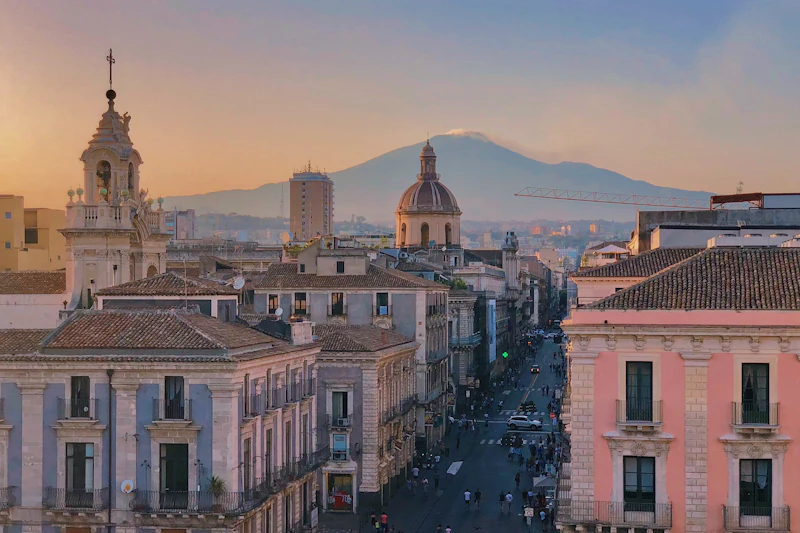
The showpiece of the Sicilian baroque, rebuilt in honey-coloured stone after the earthquake of 1693: a long main street of churches and palaces, the great staircase of the cathedral and some of the island's best almond granita.
- Half day
Vendicari & Marzamemi
~50 minA coastal reserve of lagoons, wading birds and long empty beaches around an old tuna works, then dinner in Marzamemi, a fishing hamlet built around its own old tonnara.
 → in WayoniDay trip
- Long day
Modica & Ragusa Ibla
~1 h 15 min, ~2 h Two more baroque hill towns on the UNESCO list, each a steep pile of stone and domes: Modica for its grainy cold-worked chocolate, Ragusa Ibla for its long square below the church of San Giorgio.
About Italy
Backstreets, coastline and lunch
Etruscan hills, Baroque cities and volcanic islands, with the cooking changing every fifty kilometres and nobody rushing any of it.
Explore ItalyRegions, highlights and when to go