 Italy


About Bologna
Bologna is the capital of Emilia-Romagna and home to the oldest university in the Western world, founded in 1088. Students still set its rhythm, and Italians know it by three nicknames: la Dotta, la Grassa and la Rossa, the learned, the fat and the red.
The red is brick and ochre plaster, running above more than 60 km of porticoes listed by UNESCO, enough to cross the city in the rain without an umbrella; the longest climbs 666 arches to the Sanctuary of San Luca on its hill. At the centre lie Piazza Maggiore, the vast unfinished Basilica of San Petronio and the Two Towers, a leaning pair from the dozens that noble families once raised. The Archiginnasio hides a wooden anatomy theatre, Santo Stefano a cluster of linked churches, and the Pinacoteca the Carracci and Guido Reni.
It feels lived in rather than visited, with far fewer crowds than Florence: evenings spill out along Via del Pratello and around the university quarter, and the local arguments are about football and basketball. Fast trains reach Florence in about 40 minutes and Milan in about an hour.
Eat tagliatelle al ragù, never spaghetti, then tortellini in brodo, green lasagne and mortadella from the market lanes of the Quadrilatero, with a glass of Pignoletto or Lambrusco.
Get to Bologna
Round trip from Prague, any dates in December 2026.
Buses from Bologna
Day trips from Bologna
- Half day
Modena
~30 min
A Romanesque cathedral, the Ghirlandina tower and Piazza Grande, together a UNESCO site; attics where true balsamic vinegar ages for decades in wooden barrels, and a covered market in a town that eats as seriously as Bologna.
 → in WayoniStay a night
Florence
~40 min from €4 one way
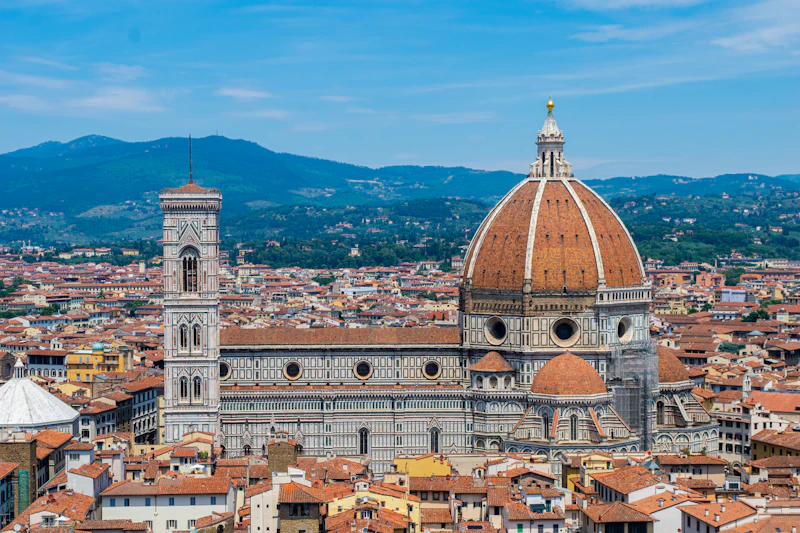
The Renaissance in one walkable city: Brunelleschi's cathedral dome, Botticelli and Leonardo in the Uffizi, Michelangelo's David at the Accademia and the Ponte Vecchio over the Arno. Book the museum slots ahead, and have a lampredotto sandwich from a market stall for lunch.
- Half day
Motor Valley
~50 min
Italy's fastest machines are built within an hour of each other: the Ferrari museum in Maranello, Lamborghini's at Sant'Agata Bolognese, Ducati's on the edge of Bologna, and the Imola circuit.
- Half day
Parma
~1 hCorreggio's dizzying dome fresco in the cathedral beside a pink marble baptistery, and the home of its ham and Parmigiano Reggiano, with dairies and curing houses to visit in the countryside around.
- Day trip
Ravenna
~1 h 10 minThe last capital of the Western Roman Empire, then the seat of Byzantine Italy: eight UNESCO monuments full of 5th- and 6th-century mosaics, from the gold and green of San Vitale to the starry vault of Galla Placidia's mausoleum, plus Dante's tomb.
About Italy
Backstreets, coastline and lunch
Etruscan hills, Baroque cities and volcanic islands, with the cooking changing every fifty kilometres and nobody rushing any of it.
Explore ItalyRegions, highlights and when to go